
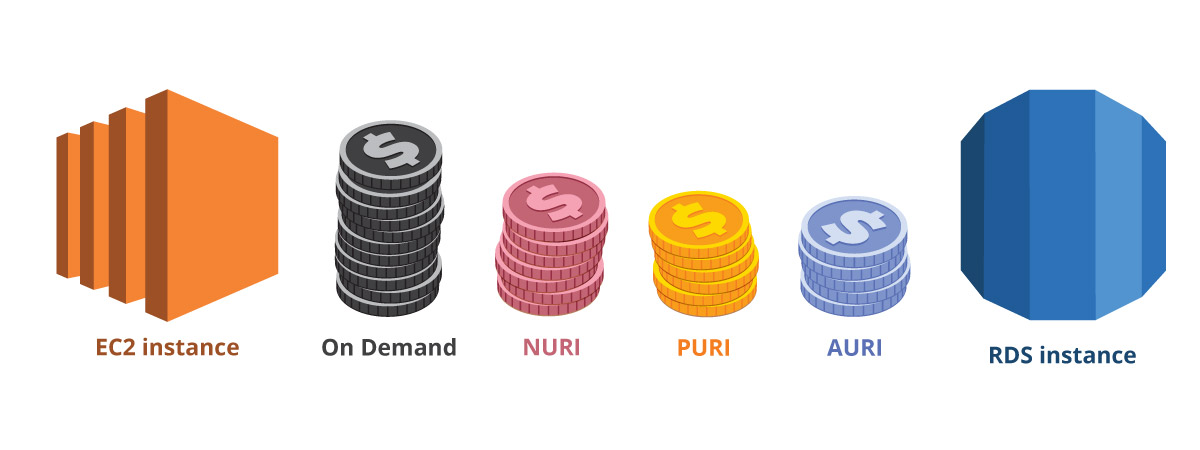
What Is PURI NURI AURI?
We’ll bet that if you’re reading this article, you either thought the headline was nuts or you read the term(s) somewhere and googled to find out what it means. Welcome to our cloud, where we frequently teach cloud computing concepts related to cloud economics. PURI NURI AURI are just that: ways to structure your cloud account to minimize expenses.
An AWS Reserved Instance (RI) is a billing discount you get for committing to a specific instance configuration for a 1- or 3-year term. AWS applies that discount automatically to any matching usage in your account, so you launch and run instances the same way you always have. For EC2, the discount can reach 72% off On-Demand pricing. RIs are available for Amazon Elastic Compute Cloud (EC2), Amazon Relational Database Service (RDS), Amazon ElastiCache, Amazon Redshift and Amazon OpenSearch Service. They’re best for workloads with steady, predictable usage.
You can choose to pay for reserved instances in one of three ways:
PURI: Partial Upfront Reserved Instance
At the start of the term, you pay a portion of the RI’s cost and the remaining hours in the term are billed at a discounted hourly rate, regardless of whether the Reserved Instance is being used.
NURI: No Upfront Reserved Instance
Without paying ahead, you are billed a discounted hourly rate for every hour within the term, regardless of whether the Reserved Instance is being used.
AURI: All Upfront Reserved Instance
At the start of the term, you pay in full, with no other costs or additional hourly charges incurred for the remainder of the term, regardless of hours used.
PURI NURI AURI FTW (When the Time Is Right)
The best way to optimize AWS costs is to let your usage data guide you. If you have a new system, it’s safest to start with On-Demand pricing. Once you’ve established a baseline, you can choose to use Reserved Instances, and then PURI, NURI, or AURI…
Ready to Build Together?
Let's talk about making your work flow with AI.
Book a Conversation